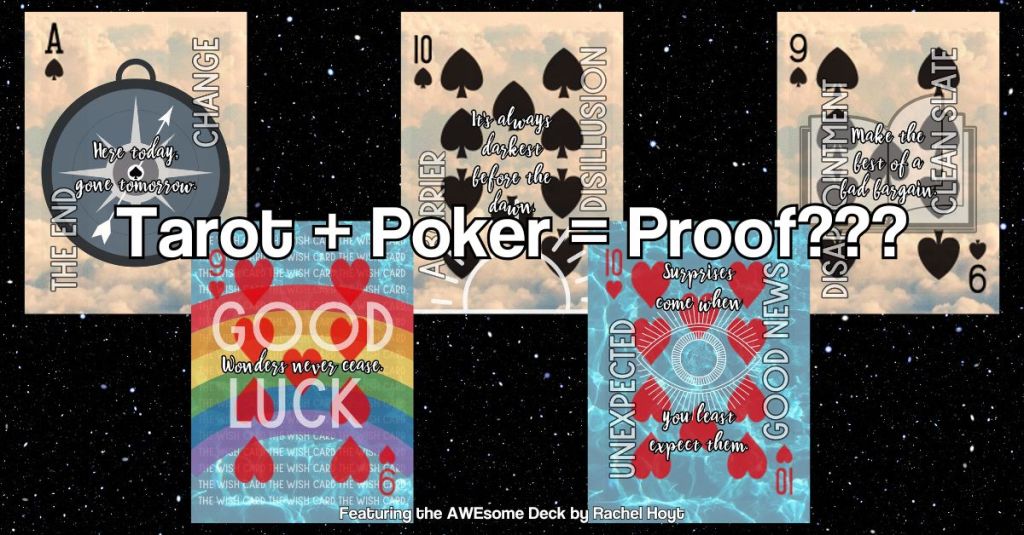
Have you seen my latest video? It explains the start of my tarot poker research – why I chose the five cards I selected as variables to track – and gives a peek at my research process.
Although I implied in the video that the hypothesis as described could be scientific proof that there is meaning in the cards, I hope you will believe me as I say that I only did that with hope of stirring up some comments from those who know the question is not yet specific enough to prove correlation (much less causation). Proving that the luckiest and most transformative (aka least lucky) cards show up far more often than mathematically expected to appear in Texas Hold’em poker hands does that and only that. It produces interesting information about a phenomenon and gives us facts to build future research upon. It’s a good place to start.
However, there’s another reason I was happy to imply that I have a scientific hypothesis which could provide concrete data on tarot utilizing Texas Hold’em poker: because I do. In fact, I have more than one. I just didn’t spell them out in that video. I bluffed.
Of course, I did mention the fact I am tracking whether or not the odds flipped when the nine or ten of hearts appeared and whether or not a player’s decision to push all-in coincided with the appearance of the ace, ten, or nine of spades… and I gave a peek at the fact I am making note of exactly where the card appeared (in the hands of the winner, loser, as a community card, etc.)… and these are much more specific facts which are part of stronger hypotheses.
Considering the community cards in a poker hand apply to all of the players in the hand and the fact that what is good luck for one player is bad luck for another, for the purposes of this study, luck is defined as an outcome not predicted by mathematical probability.
We can expect at least one of the five cards in question (ace, ten, nine of spades and ten, nine of hearts) to appear in approximately 10-30% of 2 and 3 player poker hands. (Watch this video to learn how that was calculated.)
If the nine and ten of hearts frequently appear (10% or more hands in which the pre-flop favorite (with 65%+ equity) does not win) at the moment when the odds flip in favor, this implies a correlation between luck and these cards.
If the ace, ten, and nine of spades frequently appear (15% or more hands) at the moment when a player pushes all-in, this implies a correlation between drastic change (transformation) and these cards.
I have been hesitant to define how poker hands will be chosen for analysis and precisely how many hands will be included in the study so far because… to say that I, a single individual, plan to observe, take notes, and tabulate data for ten-thousand poker hands sounds a bit unrealistic. I don’t want to tell you how many hours it has taken to create data on just over two hundred. It’s a lot. Yet, I will need to collect data on at least three-thousand hands to represent a poker player’s experience in the short run. In my opinion, that should be the bare minimum goal because ten-thousand would also only represents a small portion of all potential outcomes. (Watch my video about luck in poker to learn more about how long the short run can be for more info on that.)
The bottom line is: if my research as currently conducted is only seen to hold descriptive value, I am ok with that. We have to start somewhere. It is a daunting task which I am proud to be taking on as best I can while continually pondering ways my work could be improved.
Reminder: I currently do not earn any money for the time invested in this research project. Some of you have purchased from my Etsy shop to show your support (which is very much appreciated) and whenever I gain another 677+ followers and a few thousand more public watch hours on YouTube, I will begin to earn something for posting tarot poker videos that give you a glimpse at what I’ve seen. Nonetheless, I plan to continue observing and taking notes on poker hands as often as possible… and I will test as many hypotheses as I can come up with on as many poker hands as I can for as long as I feel called to produce the data (which will likely be the rest of my life).
To take my passion project to the next level, I went back to school via Coursera last week. So far I have completed Observational Methods and Qualitative Data Analysis, Methods for Quantitative Research in Psychology, and Introduction to Tableau. This third course was especially exciting. Tableau is a software that helps you create graphs, charts, and more with complex data sets. I can hardly wait to make some data visualizations using the info I have collected thus far!
Unfortunately, it will have to wait for a while because my full-time job, art business, and personal life need my attention too. Stay tuned.
 Rachel Hoyt
Leave a comment